

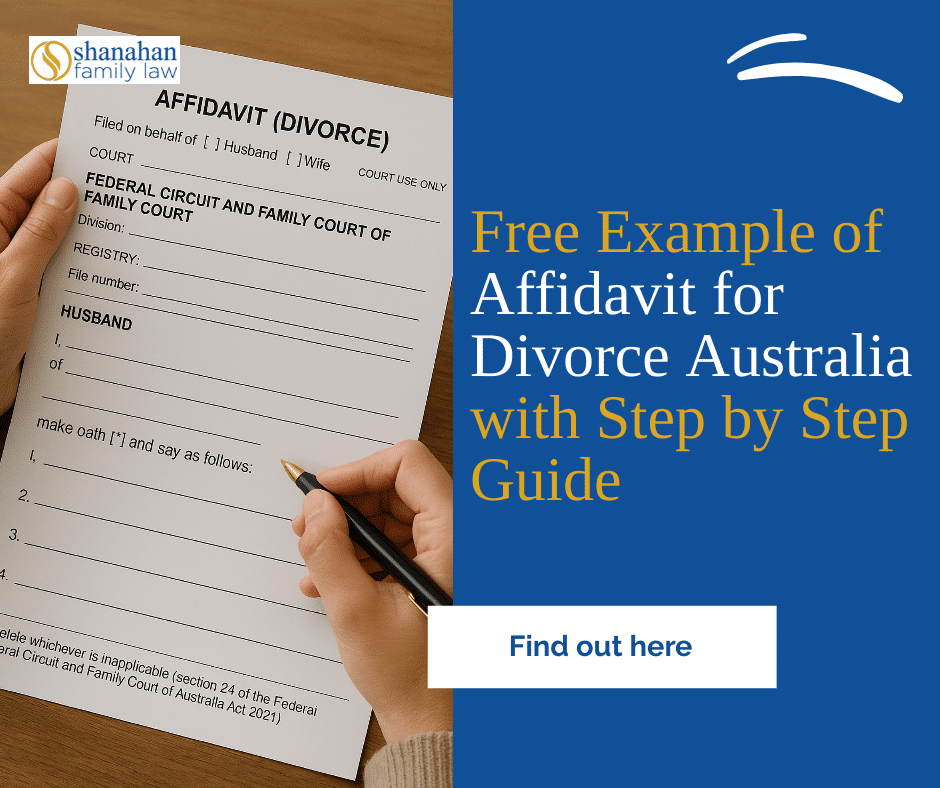
An example of an affidavit for divorce in Australia follows the format required by the Court and sets out facts such as the date of marriage, date of separation, and living arrangements, before being signed and properly witnessed for filing with the Federal Circuit and Family Court of Australia. If you are involved in family law proceedings in Australia—especially if you are applying for divorce and need to prepare an affidavit that meets Court requirements—this guide shows you how these affidavits are set out, what they need to say, when they are used, and how to avoid mistakes that can cause delay or rejection.
We’ve put together examples of divorce affidavits, including affidavits for separation under one roof, along with the rules on witnessing, attaching documents, filing through eFiling, and recent legal changes that affect affidavit requirements. Do you want further support? Our divorce lawyers on the Sunshine Coast can give you personalised advice.
Affidavit readiness check
Work out whether the Court may need an affidavit with your divorce application, and organise your notes before you speak with a lawyer. Takes about five minutes. This tool does not write an affidavit for you.
Affidavit Readiness Check
Shanahan Family Law · Maroochydore · Sunshine Coast
Key takeaways
What is an affidavit for divorce Australia?
If you need to provide evidence to the Family Court, an affidavit is what you’ll use. For example, you might continue living with your former partner after you separate. The Court will want to be sure that you are actually living separate lives. An affidavit is what you use to do that.
They’re sworn or affirmed to show that you, as the deponent, promise that what’s in the affidavit is truthful. You have to sign each page of the affidavit in front of an authorised witness before it’ll be accepted.
Preparing an Affidavit Form for Divorce
The Court only wants to hear the facts of what happened, so leave out your opinions and any hearsay from third parties when drafting your affidavit.
Be comprehensive and include all the facts as you remember them in chronological order, because missing evidence can create problems for your case later on.
Use clear headings and paragraphs, and number every paragraph so they can be referred to easily, with each paragraph addressing only one point.
The Court generally expects affidavits to be clearly formatted with size 12 font, 1.5 line spacing, single-sided printing and numbered pages, so check the current FCFCOA practice direction before filing as formatting requirements may change.
If you’re using a third-party affidavit, the person providing it must be over 18 and should only include information they know personally rather than anything they’ve heard from others.
The deponent must sign the bottom of each page of the affidavit in the presence of an authorised person before it can be accepted by the Court.
Attaching Documents to Your Divorce Application
You might reference other documents in your affidavit. This could be things like marriage certificates and child support agreements. They must be attached as annexures. Each annexure should be:
Labelled with a reference letter or number (e.g. “Annexure A”).
Accompanied by a statement: “This is the document referred to as Annexure [insert reference number] in the affidavit of [insert deponent’s name], sworn/affirmed at [insert place] on [insert date] before me, [authorised person’s signature], [name and qualification].”
Signed and witnessed by an authorised person.
Federal Circuit and Family Court of Australia Affidavit
Filed on behalf of: [Applicant’s full name] Date: [DD/MM/YYYY]
I, [Full legal name], of [Residential address], [Occupation], SAY ON OATH/AFFIRM:
I am the Applicant in this matter.
I was married to [Respondent’s full name] on [DD/MM/YYYY] at [Location of marriage].
A copy of our marriage certificate is annexed and marked “A”.
We separated on [DD/MM/YYYY] and have lived separately and apart since that date.
There is no reasonable likelihood of resuming cohabitation.
Witnessing Rules in Queensland
Affidavits may be rejected if they are not witnessed correctly. The rules below apply in Queensland. New South Wales and Victoria have their own witnessing requirements under different legislation.
Authorised witnesses
In Queensland, the Oaths Act 1867 (Qld) sets out who can act as an authorised witness. If the affidavit is being witnessed in person, an authorised witness may be:
A Justice of the Peace (JP).
A Commissioner for Declarations (Cdec).
A notary public.
A lawyer.
A conveyancer.
There may be times when an affidavit can’t be witnessed in person. It’s also possible for witnessing to occur via an AV link. In these cases, you may need a special witness. The Queensland Government has listed the following as special witnesses:
An Australian legal practitioner.
A government legal officer who is an Australian lawyer and witnesses documents as part of their government work.
A JP or Cdec who has been approved as a special witness.
If the document was prepared by a law practice, a JP or Cdec employed by the law practice who witnesses documents as part of their employment.
A notary public.
If the document was prepared by the Public Trustee of Queensland, a JP or Cdec employed by the Public Trustee.
Under Queensland legislation, there is a distinction between a ‘lawyer’ and a ‘legal practitioner’ for the purposes of acting as an authorised witness. A lawyer is a person admitted to the legal profession in Queensland or another jurisdiction. A legal practitioner is a lawyer who holds a current practising certificate. Only legal practitioners may act as a special witness in Queensland. Other states use different terminology and rules.
Separation under one roof affidavit
The law allows separated couples in Australia to continue to live together after separation in the same home. The only ground for divorce is irretrievable breakdown, shown by separation for at least 12 months, including where parties remain under the same roof. However, the couple have to show that they’re living separate lives, even while cohabiting. To demonstrate this, both parties should prepare an affidavit to explain the situation. The affidavits have to show what the relationship was like before the separation, and how things have changed post-separation.
Who completes the affidavit?
When you’re applying for a divorce jointly through Joint Applications, both of the spouses generally write an affidavit. If you’re making a Sole Application, you may need to complete an affidavit yourself and get a third party, like a family member or friend who knows about your situation, to complete one as well.
What should the affidavits include?
The point of the affidavits is to show the Court how your domestic arrangements have changed as a result of the separation, and they may need extra evidence if you were living under one roof. Make sure that the affidavits don’t contradict each other on any point. The affidavits could talk about things such as:
Separation date. Mark the date that the separation started. Explain how the separation was communicated. For example, you may have discussed it verbally or put it in an email. The Court may also require further information about when and how that separation was communicated.
Living arrangements. Detail how the way you live has changed. This may include:
Sleeping in different bedrooms.
Maintaining separate living areas in the house.
Not sharing domestic duties.
Not eating meals together.
Financial separation. There may be financial matters you could talk about, such as:
Closing joint bank accounts and opening individual ones.
Dividing how bills are paid.
Social aspects. Explain what steps you’ve taken to change the way your relationship is seen socially, such as:
No longer attending social events together.
Maintaining separate social circles.
Why you’re cohabiting. Give the reasons why you decided to keep living together. This may include the following:
It’s not financially possible for you to maintain separate accommodation.
Your parenting responsibilities require you to remain in the same home.
There isn’t any suitable accommodation nearby.

Legal Requirements and Recent Changes
If you have been married for less than two years before filing, counselling is required and you must file a counselling certificate before applying for divorce, unless the Court allows the matter to proceed without one. This requirement comes from section 44(1B) of the Family Law Act 1975. Speak with a family lawyer about your specific circumstances.
The Court must be satisfied that there are proper arrangements for any children before granting the divorce.
The Family Law Rules require an affidavit to be sworn or affirmed as true to the best of the deponent’s knowledge.
If you are seeking specific orders, your affidavit should support those orders clearly.

eFiling Application Process
Include all affidavit for divorce Australia with your application. The divorce application is usually filed as an Online Application through the Commonwealth Courts Portal. The standard Filing Fee for divorce applications is $1060. Some applicants may be eligible for a Reduced Fee if they can show Financial Hardship. Following a proven example of an affidavit for divorce helps avoid these delays.
From our clients
The team at Shanahan Lawyers were professional and really took the time to understand my situation. They gave clear advice and explained things in a way I could follow. Worth every cent. Thank you. — D.
I can highly recommend Luke and his associates for their professionalism and thoughtfulness. I didn’t know what to expect when I first needed a solicitor, but Luke was patient and kind in guiding me through the process. — A.
Frequently asked questions
What other affidavits may be needed for a divorce?
In addition to the affidavit of eFiling and separation under one roof, there are other times when an affidavit may be required, such as:
Service difficulties. Sometimes, spouses can make it difficult to serve them. In a sole application, the applicant must serve a sealed copy of the application on the other party. Personal service by the spouse or applicant is not allowed, but the documents can be served by mail to the respondent’s address where appropriate. An Acknowledgement of Service and related forms are usually required after service. You may ask the Court for substituted service or to waive the need for service entirely. An affidavit may be required to explain all the reasonable steps you took to contact them.
Lack of a marriage certificate. There may be a situation where you’ve lost your marriage certificate and are unable to get a replacement. You may need to draft an affidavit that explains your efforts to locate the certificate and evidence that a replacement isn’t possible.
What are the consequences of getting an affidavit wrong?
The Court may adjourn the matter, ask for further information, or require a fresh affidavit if the document is incomplete, inaccurate, or inconsistent.
Can I amend an affidavit?
Yes, but it is usually better to correct issues promptly and follow the Court’s process for filing updated material.
Do I need to attend the divorce hearing?
Attendance at the divorce hearing may be required depending on the circumstances, especially if there are children under 18, a response has been filed, or the Court needs clarification. After filing, the Court allocates a hearing date, and if the application is granted, the divorce order becomes final one month and one day later. The Court then issues the order with an electronic seal as the official record.
Conclusion
A lot of what makes an affidavit for divorce Australia in family law effective is in its formatting and wording. There are very particular points that need to be met. This is why it can be useful to see what an example affidavit looks like. Correct witnessing can also be a sticking point for a lot of applicants. Use an authorised witness and make sure that everything is signed as needed.
Speak to a family lawyer about your specific circumstances.
This article provides general information only. It is not legal advice. Family law outcomes depend on your circumstances. You should speak with a family lawyer before making decisions about your matter.
Last reviewed: 06 August 2026 by Luke Shanahan, Principal Solicitor.
